Modelling Acoustic Wave Propagation in Batteries: From Physics to Usable Tooling
Feb 1, 2026
Modelling Acoustic Wave Propagation in Batteries: From Physics to Usable Tooling
Acoustic methods are an increasingly attractive way to probe battery state without tearing cells apart. Changes in temperature, state of charge, and mechanical condition all affect how acoustic waves travel through a cell. The challenge is not generating acoustic signals — it’s interpreting them.
During a consultancy project with Sention, we built a modelling framework designed to bridge that gap: a fast, configurable acoustic wave model of a layered battery structure that could be rerun by non-modelling specialists to match experimental data and extract effective material properties.
This post outlines the design decisions behind that framework, from the physical model through to the software architecture, and why simplicity and efficiency mattered more than dimensional fidelity.
Design goals
From the outset, the project had a few clear constraints:
Usable by non-modellers
Experimentalists needed to rerun simulations without touching PDE solvers or numerical settings.Fast and configurable
The primary task was parameter variation: acoustic velocity, density, impedance, attenuation — across electrodes, separators, and current collectors.Scalable for dataset generation
The long-term goal was not just individual fits, but the creation of a large synthetic dataset for future machine learning models.Physically grounded but minimal
A model that captured the dominant physics of wave propagation, without unnecessary complexity.
This led directly to a 1D layered acoustic model, prioritising speed, robustness, and interpretability.
Physical model: 1D layered acoustics
The battery was represented as a 1D stack of material layers, corresponding to:
Positive electrode
Separator
Negative electrode
Current collectors
Each layer was assigned its own acoustic properties (e.g. wave speed, density, impedance), allowing discontinuities at interfaces and reflections to emerge naturally from the physics.
While clearly an approximation, the 1D assumption offered two key advantages:
It captures the dominant through-thickness wave behaviour relevant to many experimental setups.
It allows extremely fast simulation and dense parameter sweeps.
The goal was never to perfectly reproduce every experimental detail, but to build a useful inverse tool.
Numerical engine: why Clawpack?
For the underlying physics engine, we used Clawpack, a finite-volume framework designed for hyperbolic PDEs and wave propagation problems.
Clawpack was a good fit because it provides:
Robust handling of wave propagation and reflections
Clear separation between physics and numerics
Excellent performance for 1D problems
Mature, well-tested solvers
Crucially, it allowed the physics to remain explicit and inspectable, rather than hidden behind a black-box solver.
A domain-specific API for battery acoustics
To make the model usable, we built a small domain-specific API on top of Clawpack.
Instead of defining grids and coefficients manually, users could specify:
Layer ordering (electrode / separator / current collector)
Thicknesses
Acoustic properties per layer
Source and sensor locations
This abstraction meant that changing a material property or layer configuration became a matter of editing a few parameters — not rewriting solver code.
End-to-end architecture
To make the system easy to deploy and rerun, the full workflow was containerised and split into three main components:
Backend
Dockerised Clawpack-based simulation server
Exposed via an API for parameterised runs with FastAPI
Frontend
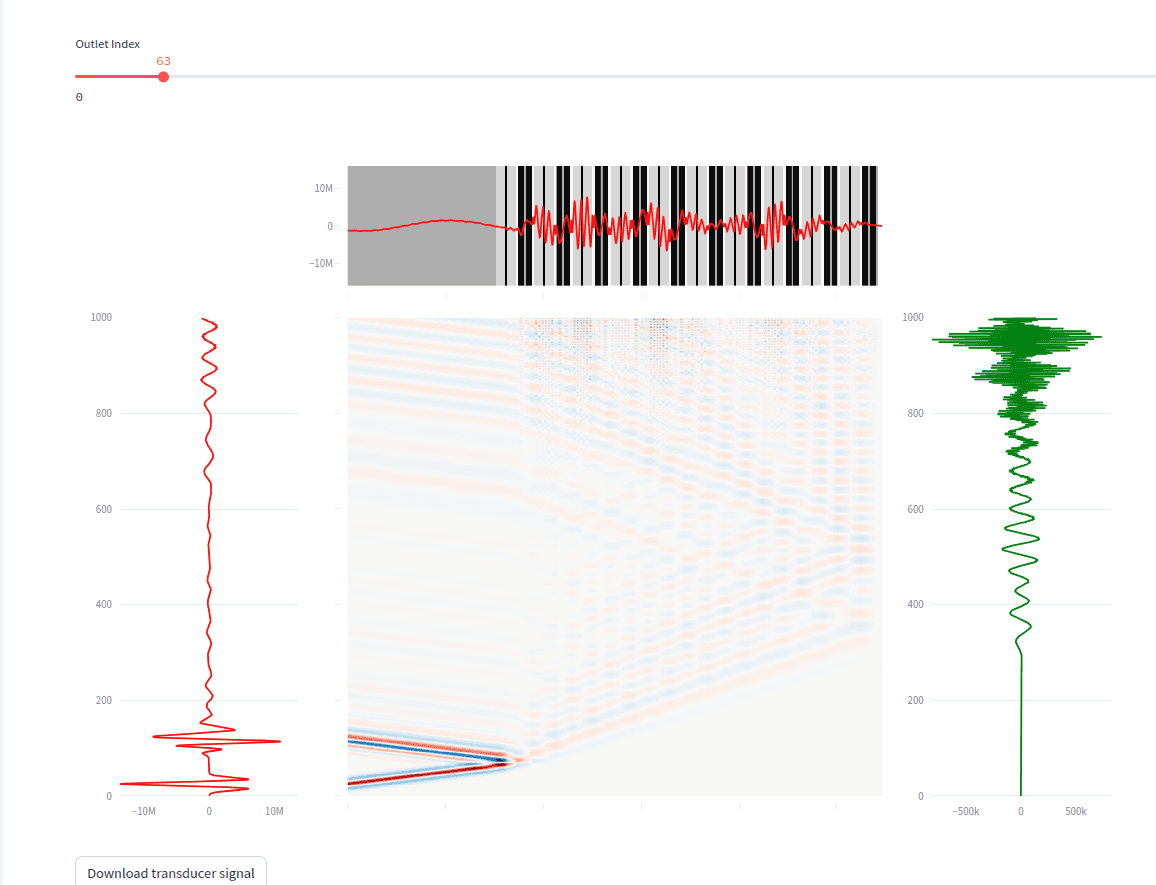
Built in Streamlit
Interactive control of layer properties
Immediate visualisation of wave propagation and received signals
Workflow
User selects layer properties and experimental conditions
Backend runs the acoustic simulation
Results are returned and visualised
Parameters are adjusted to match experimental data
This setup allowed experimentalists to explore “what-if” scenarios without needing to understand the underlying PDEs.
Matching experimental data
A typical use case was:
Fix the known geometry
Vary acoustic properties with temperature and state of charge
Compare simulated and measured signals
Identify effective material parameters that best explain the data
Because simulations were fast and reproducible, it was practical to run large parameter sweeps and build intuition about sensitivity and identifiability.
Towards data-driven interpretation
While the immediate goal was parameter fitting, the longer-term vision was to generate large synthetic datasets spanning:
Material property variations
Temperature
State of charge
These datasets could then be used to train machine learning models capable of rapidly interpreting acoustic signals — effectively learning the inverse mapping that is expensive to compute directly.
The modelling framework was designed with this future step in mind from day one.
Closing thoughts
This project reinforced a recurring lesson in applied modelling: the most useful model is rarely the most detailed one.
By focusing on:
the dominant physics,
a clean abstraction layer,
and strong tooling around the solver,
it was possible to build a framework that served both immediate experimental needs and future data-driven ambitions.
If you’re interested in acoustic diagnostics, inverse problems, or building modelling tools that non-specialists can actually use, this kind of approach scales surprisingly well.